martes, 22 de marzo de 2011

Video Formats-FAST FACTS


---DVD---
  1. DVD discs offer higher storage capacity than compact dics while having the same dimensions.
  2. DVD-ROM because data can only be read and not written nor erased.
  3. he DVD is made of a spiral groove read or written starting at the center. The form of the groove encodes unalterable identification data known as Media Identification Code
---Mini DV---
  1. is a DVd disc having 8 cm in diameter.
  2. A MiniDV can be played back in most DVD players that are tray loaded.
Physical sizeSingle layer capacityDual/Double layer capacity
12 cm, single sided4.7 GB8.5 GB
12 cm, double sided9.4 GB17 GB
8 cm, single sided1.4 GB2.66 GB
8 cm, double sided2.8 GB5.2 GB

---.AVI---

  1. AVI files can contain both audio and video data in a file container that allows synchronous audio-with-video playback
  2. AVI divides a file's data into blocks, or "chunks." Each "chunk" is identified by a FourCC tag.
  3. AVI is not intended to contain variable frame rate material.
---.MPEG---
  1. The MPEG compression methodology is considered asymmetric as the encoder is more complex than the decoder
  2. MPEG is a working group of experts that was formed to set standards for audio and video compression and transmission.
MPEG groups of standards[25][26][27][46][47]
Acronym for a group of standards↓Title↓ISO/IEC standards↓First public release date (First edition)↓Description↓
MPEG-1Coding of moving pictures and associated audio for digital storage media at up to about 1,5 Mbit/sISO/IEC 111721993
MPEG-2Generic coding of moving pictures and associated audio informationISO/IEC 138181995
MPEG-3abandoned, incorporated into MPEG-2
MPEG-4Coding of audio-visual objectsISO/IEC 144961999
MPEG-7Multimedia content description interfaceISO/IEC 159382002
MPEG-21Multimedia framework (MPEG-21)ISO/IEC 210002001
MPEG-AMultimedia application format (MPEG-A)ISO/IEC 230002007
MPEG-BMPEG systems technologiesISO/IEC 230012006
MPEG-CMPEG video technologiesISO/IEC 230022006
MPEG-DMPEG audio technologiesISO/IEC 230032007
MPEG-EMultimedia MiddlewareISO/IEC 230042007
(none)Supplemental media technologiesISO/IEC 291162008will be revised in MPEG-M Part 4 - MPEG extensible middleware (MXM) protocols
MPEG-VMedia context and controlISO/IEC FDIS 23005[37]under development
MPEG-MMPEG extensible middleware (MXM)ISO/IEC 23006[42]2010
MPEG-URich media user interfacesISO/IEC 23007[44]2010
---.DIVX---
  1. DivX 6 expanded the scope of DivX from including just a codec and a player
  2. It is one of several codecs commonly associated with "ripping", whereby audio and video multimedia are transferred to a hard disc and transcoded
  3. This new "DivX Media Format" also came with a "DivX Ultra Certified" profile, and all "Ultra" certified players must support all "DivX Media Format" features.
--MP4--
it is fully compatible and still is in development. It is able to mix different types of data like video, audio and speech.


FOR FURTHER INFOMATION CHEK OUT THIS LINK
http://www.asharer.com/wp-content/uploads/2010/11/flash-swf-video-format.jpg

martes, 1 de marzo de 2011

Linux,Moodle and Open Office


MOODLE
Moodle stands for Modular Object-Oriented Dynamic Learning Environment, and it is a free and open-source learning software platform. Martin Dougiamas iniatially startedto develop it to help educators create online courses. The enterprise is located in Wester Australia and most of the development of MOODLE is done there.

LINUX
Linux refers to all the Unix-like family of computer operating systems. It is functional in a wide range of computer hardware. Linxus is a leading server operating system and runs the 10 fastest supercomputers in the world. Linux is one of the most prominent examples of free and open source software, for it can be used, freely modified, and redistributed, both commercially and non-commercially,

OPEN OFFICE
Open Office is sometimes called OOo but its actual name is Open Office.org It is an open-source application with its main components in word processing, spreadsheets, presentations, graphics and databases. It is a free software and is available and various operating systems. In November 2009 it already supported 110 languages. It started as StarOffice by StarDivision and acquired by Sun Microsystems in August 1999. The source code was released in July of 2000. It is primarily sponsored by Oracle Coproration (who bought Sun Microsystems).

OUR MOODLE!!

martes, 25 de enero de 2011

Open Source Initiative

The Open Source Initiative (OSI) is an organization dedicated to promoting open source software.The organization was founded in February 1998, by Bruce Perens and Eric S. Raymond, prompted by Netscape Communications Corporation publishing the source code for its flagship Netscape Communicator product. Later, in August 1998 the organization added a board of directors.Raymond was president from its founding until February 2005. The current president is Michael Tiemann.

Facts:

Questions:

  • ¿Why is it called Open source?
  • Because The program publishes the code


Although born from the same history of Unix, Internet free software, and the hacker culture as the free software movement launched by Richard Stallman and his Free Software

Foundation, the Open Source Initiative was formed and chose the term open source, in Michael Tiemann's words, to "dump the moralizing and confrontational attitude that had been associated with 'free software' in the past and sell the idea strictly on the same pragmatic, business-case grounds that had motivated Netscape.

Stallman counter-charges that OSI's pragmatic focus on a model for software development and marketing ignores what he considers to be the central "ethical imperative" and the focus on "freedom" that underlies free software, as he defines it, and blurs the distinction with semi-free or wholly proprietary software.

Notes

Freeware=Free=Public Domain-You can even sell it if you want

Semi-Free=Shareware-Voluntary buying of the program-DONATIONS

Wholly Proprietary-buy liscense to use it

SOURCE:WIKIPEDIA

lunes, 24 de mayo de 2010

audacity

1- Track.
A track is a dispositive like a hard disk or a magnetic radiocasette that can record and store sound, video, music...
2- Editing
Editing is the process of selecting and preparing language, images, sound, video, or film through processes of correction, condensation, organization, and other modifications in various media. A person who edits is called an editor.
3- Boom pole operator.
The boom operator is an assistant to the production sound mixer, responsible for microphone placement and movement during filming. The boom operator uses a boom pole, a long pole made of light aluminum or carbon fiber that allows precise positioning of the microphone above or below the actors, just out of the camera's frame. The boom operator may also place radio microphones and hidden set microphones. In France, the boom operator is called the perchman.
4- Sound mixer.
An audio engineer who performs the sound mix. The SOUND MIX is the process of re-recording multiple reels of track to produce one final soundtrack
5- Production sound.
Production sound is a dialogue and ambient sound recorded during filming.
6- Post production.
Post-production is part of the filmmaking process. It occurs in the making of motion pictures, television programs, radio programs, videos, audio
7- Added sounds: ambiance; effects.
8- Split: what happens when you split a sound file.
9- What do you split a sound file for?
10- Fade in/fade out.

lunes, 17 de mayo de 2010

Audacity

1- What is a sound?
Sounds are pressure waves of air. If there wasn't any air, we wouldn't be able to hear sounds. There's
no sound in space.
2- What is the speed of sound?
340 meters per second
3- What is faster, the speed of light or the speed of sound?
The speed of light
4- How do you record a sound?
A microphone consists of a small membrane that is free to vibrate, along with a mechanism that
translates movements of the membrane into electrical signals. (The exact electrical mechanism varies
depending on the type of microphone.) So acoustical waves are translated into electrical waves by
the microphone. Typically, higher pressure corresponds to higher voltage, and vice versa.
5- What is the difference between digital and analog sound?
Recording onto a tape is an example of analog recording. Audacity deals with digital recordings −
recordings that have been sampled so that they can be used by a digital computer, like the one you're
using now.
6- Write 3 advantages of digital sound over analog sound?
Digital recording has a lot of benefits over analog recording. Digital files can be copied as many times you want, with no quality loss;and they can be burned to an audio CD or shared via the Internet.
7- What are the factors that determine the quality of digital sound?
There are two factors that determine the
quality of a digital recording:
Sample rate: The rate at which the samples are captured or played back, measured in Hertz
(Hz), or samples per second. An audio CD has a sample rate of 44,100 Hz, often written as
44 KHz for short. This is also the default sample rate that Audacity uses, because audio CDs
are so prevalent.
·
Sample format or sample size: Essentially this is the number of digits in the digital
representation of each sample. Think of the sample rate as the horizontal precision of the
digital waveform, and the sample format as the vertical precision. An audio CD has a
precision of 16 bits, which corresponds to about 5 decimal digits.
8- What audio file formats does Audacity support?
MP3 (MPEG I, layer 3), Ogg Vorbis, and WMA (Windows Media
Audio). Audacity supports MP3 and Ogg Vorbis, but not the proprietary WMA format or the
MPEG4 format (AAC) used by Apple's iTunes
9- Write the difference between PCM audio files and Compressed ones?
PCM stands for Pulse Code Modulation. This is just a fancy name for the technique described
above, where each number in the digital audio file represents exactly one sample in the
waveform. Common examples of PCM files are WAV files, AIFF files, and
Sound Designer II files. Audacity supports WAV, AIFF, and many other PCM files.
·
The other type is compressed files. Earlier formats used logarithmic encodings to squeeze
more dynamic range out of fewer bits for each sample, like the u−law or a−law encoding in
the Sun AU format. Modern compressed audio files use sophisticated psychoacoustics
10- Write examples of each one of them.

http://dl.dropbox.com/u/6991882/audacity-manual-1.2.pdf

http://audacity.sourceforge.net/?lang=es

lunes, 8 de marzo de 2010

Scribus, GIMP

Scribus

Scribus es un programa de software libre para autoedición, que ofrece un gran rendimiento en la creación de publicaciones por ordenador. Scribus está disponible en versiones nativas para GNU/Linux, Unix, Mac OS X y Windows y brinda capacidades para el diseño y diagramación, similares a las ofrecidas por programas comerciales como Adobe PageMaker, QuarkXPress y Adobe InDesign.

La aplicación está diseñada para dar flexibilidad en el diseño y la composición, ofreciendo la capacidad de preparar archivos para equipos profesionales de filmación de imágenes. También puede crear presentaciones animadas e interactivas en PDF y formularios. Entre los ejemplos de su aplicación se encuentran pequeños periódicos, folletos, boletines de noticias, afiches y libros.

Scribus soporta la mayoría de los principales formatos gráficos además de SVG. Sus características profesionales para fuentes e imágenes incluyen manejo de color CMYK y administración de color ICC. Ha sido desarrollado mediante scripting usando Python y está disponible en más de 24 idiomas.

GIMP
GIMP (GNU Image Manipulation Program) es un programa de edición de imágenes digitales en forma de mapa de bits, tanto dibujos como fotografías. Es un programa libre y gratuito. Está englobado en el proyecto GNU y disponible bajo la Licencia pública general de GNU.

La primera versión de GIMP se desarrolló inicialmente en sistemas Unix y fue pensada especialmente para GNU/Linux. Existen versiones totalmente funcionales para Windows, para Mac OS X, y se incluye en muchas distribuciones GNU/Linux. También se ha portado a otros sistemas operativos, haciéndolo el programa de manipulación de gráficos disponible en más sistemas operativos. Se le puede considerar como una alternativa firme, potente y rápida a Photoshop para muchos usos, aunque no se ha desarrollado como un clon de él y posee una interfaz bastante diferente.

GIMP está disponible en varios idiomas, entre ellos: español, alemán, inglés, catalán, gallego, euskera, francés, italiano, ruso, sueco, noruego, coreano, neerlandés y en otras lenguas adicionales.

lunes, 1 de marzo de 2010

El Viejo Pescador


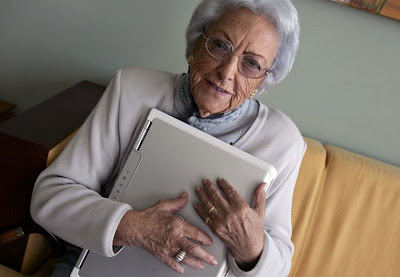
Maria Amelia,la anciana a quien su nieto regaló un blog por su 95 cumpleaños, y ella se entusiasmó, convirtiéndose en la usuaria más vieja del mundo y posiblemente, la más ilusionada.Al descubrir el internet, descubrió un escape para luchar contra la soledad y María Amelia lo aprovechó a fondo. Y lo hizo en bien de la gente de su edad. Murió en mayo de 2006, casi tres años después, habiendo vivido a fondo con la última tecnología a su servicio. . María Amelia recibió el prestigioso premio internacional BOBs, el más importante del mundo en su especialidad, que se otorga en Alemania. Hasta Zapatero la había recibido.

Pero María Amelia está muerta, y viene el olvido.Para que ni ella ni sus deseos se disuelvan en el viento, he aquí una de sus muchas frases que dejó en su blog. Una definición de principios que ayudó a muchos mayores: “Mi blog es para entretenerme y comunicarme con mis blogueros. Y para animar a todos los ancianos a que tengan el Internet. Y para que sus familiares hagan un esfuerzo por enseñarles. Así podrán conocer gente nueva, comunicarse y aprender cosas todos los días. A mí me sacó 20 años de encima. Todos los ancianos, con un Internet”.
http://www.elpais.com/articulo/portada/Maria/Amelia/Viejo/Pescador/elpepusoceps/20100221elpepspor_1/Tes